
Who was Anarkali?
A meek damsel overwhelmed by the love and attention of a strapping young man… or an aware woman intelligent enough to secure the power centre of the future?
Anarkali intrigued me. Not the love story between her and Salim or her defiance of Akbar’s diktat. But Anarkali, the woman who made the choices that led her to be immured into a Lahore Fort wall.
Nothing substantial is available about Anarkali’s life or her family, roots, ancestry or life in Akbar’s Harem. Surprisingly, she doesn’t find space even in the Akbarnama or Tuzuk-e-Jahangiri, the memoirs of Akbar and Salim, the two men who claimed to love her. She was first mentioned by an English tourist and trader as a byline long after her death.
Anarkali, a woman loved by many but understood by none, was Anarkali a piyada, a pawn in the hands of a controlling monarch, or was she the Asb, the attacking piece, the knight?
Anarkali’s dream of becoming a celebrated courtesan in the Harem of Mughal Emperor Akbar in 16th-century Hindustan is realised. The life she had yearned for at the Shahi Mahal of Lahore becomes mundane, losing its sheen after a few years. The young girl who enjoys the chase finds her restless, free spirit wanting more. In the midst of this ennui, Anarkali is pulled into a taboo relationship with the childlike Salim, the heir apparent and favourite son of the Akbar-e-Azam.
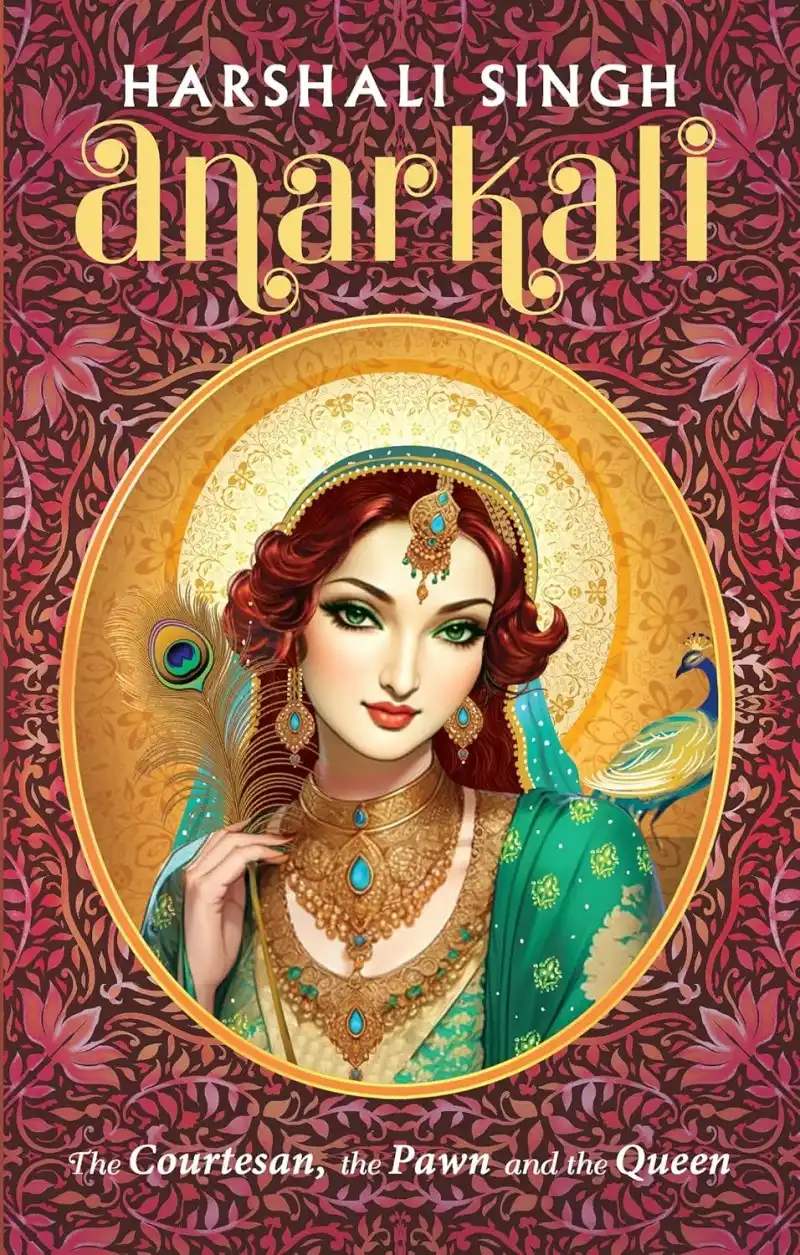
Marooned amid relationships that shatter her heart and threaten her life, Anarkali traverses the intrigues of the royal Harem using her wiles to survive while skirting passion, danger and violence. Torn between her ambition and what her heart desires, Anarkali uses her charms, knowing men only want parts of her and never the whole. Teetering between wanting to believe in love and facing the harsh realities of her life, Anarkali makes the ultimate mistake of raising her voice against powerful men.
Was she purposefully erased from the annals of history for questioning free will?
And yet her story resonates even today, its myriad connotations catching the listener’s imagination, resulting in a rainbow of possibilities and hope.
Despite the numerous interpretations and labels, Anarkali remains shrouded in mystery, fading slowly from the collective memories.
Anarkali, known for her beauty and tragic love, forever made immortal by the face of the mesmerising Madhubala pining for her Salim even as the last brick is secured. However, this surely cannot be her only claim to fame.
We, as women, are more than who we choose to love.
What did the young girl who gave birth to Akbar’s son, Prince Daniyal, want for herself? What choices did she make to secure her position in the royal court? Did Akbar retract his order to bury her in a wall or find a way for her to escape? The questions are endless.
The book Anarkali- The Courtesan, the Pawn and the Queen is a glimpse into the life of Sharf-un- Nisa later christened Anarkali by a besotted Akbar. A fragmented picture of a famed, ethereal, lonely courtesan and a lost Prince. The story of Anarkali is undoubtedly an illustration of the oppressed taking back control from the powerful.
The story of Anarkali, the woman, narrated from her perspective and voice, shall offer a fascinating look into the dynamics of power, love and relationships. It is an unveiling but is fundamental and honest for this very reason.
There is no dearth of powerful women who were the change makers, but due to the times they lived in, there was significantly less recognition or credit given. Power dynamics were shaped in such a way that women were left holding the short end of the stick.
Their stories serve as a ready reckoner for the woman of these times who can relate to thwarted desires and unsatisfied ambitions. It is, therefore, our duty as writers to shine a light on their positive qualities: the courage, the survival instinct, and the core emotional strength to withstand the unfairness meted out to them and yet thrive. To understand that women need to support each other to rise as a tribe. To talk of inclusivity and that help can come from the most unexpected quarters.
In this world that is slowly losing its humanity, we need more stories that embrace the emotional quotient, the compassion that is intrinsic to us all. If even one man reads a story of a woman in an undesirable situation and course corrects or is at least moved to think about his behaviour and the consequences of his entitled life, these stories would have served their purpose.
If even one woman at the end of her rope finds strength through these stories of valour, of holding on for another day, then as writers, we would have succeeded, as would the protagonists of our stories.
Anarkali is my attempt to portray a self-aware woman who unabashedly makes choices that go against what society considers a heroine. My Anarkali knows love is also a weapon that can be used efficiently to survive. I believe a courtesan who could traverse the challenging terrain of a Mughal Harem could not have been the one-dimensional woman as portrayed by everyone.
She has myriad facets that some may find difficult to accept.
- Author: Harshali Singh